What tests are usually needed to diagnose an elbow fracture accurately?
An elbow injury can happen after a fall, sports injury, direct blow, or accident. Sometimes the pain and swelling are obvious, while in other cases, a fracture may be difficult to identify without proper examination and imaging. Getting an accurate diagnosis is important because different elbow fractures may require different approaches to treatment and recovery.
For fast information direct chat with us on WhatsApp.
At Little Bones Clinic, the evaluation usually begins with a physical examination followed by imaging when a fracture is suspected. For people seeking Elbow Fracture Treatment in Indirapuram, understanding these diagnostic tests can make the process less confusing and help patients know what to expect.
Why is an accurate elbow fracture diagnosis important?
The elbow is a complex joint where three bones meet: the humerus, radius, and ulna. A fracture can occur in any of these bones, and the injury may affect the joint surface or the alignment of the bones.
An accurate diagnosis helps the doctor understand:
- Which bone is fractured
- Where the fracture is located
- Whether the bone has shifted
- Whether the joint is involved
- Whether there may be associated soft-tissue or nerve problems
- What type of treatment may be appropriate
As explained by Little Bones Clinic, the first assessment is important because an elbow injury that appears minor may still need careful evaluation.
What tests are used to diagnose an elbow fracture?
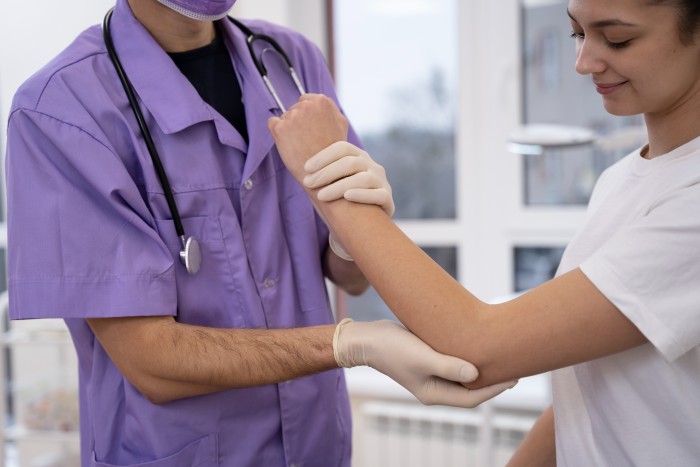
Physical examination
Before ordering imaging, the doctor examines the injured elbow. This may include checking for tenderness, swelling, bruising, deformity, and the range of movement.
The doctor may also assess the hand and forearm for circulation and sensation. Checking these areas is important because nerves and blood vessels pass close to the elbow.
A physical examination alone may not confirm a fracture, but it helps the doctor decide which investigations are needed.
X-ray of the elbow
An X-ray is commonly the first imaging test used when an elbow fracture is suspected. It can show many fractures and provide information about the position and alignment of the bones.
Different X-ray views may be taken to examine the elbow from more than one direction. This can help the doctor identify a fracture that might not be clearly visible on a single view.
X-rays can also help determine whether the bones have moved out of their normal position. This information can be useful when planning Elbow Fracture Treatment in Indirapuram.
However, not every fracture is immediately obvious on an X-ray. If symptoms strongly suggest a fracture despite an unclear X-ray, the doctor may consider additional imaging.
CT scan
A CT scan creates detailed cross-sectional images of the elbow. It can provide more information about the shape, location, and complexity of certain fractures than a standard X-ray.
Doctors may consider CT imaging when the fracture is complex, involves the joint surface, or needs more detailed assessment for treatment planning.
For example, a complicated fracture around the elbow may require a clearer understanding of the bone fragments and joint involvement. In such situations, a CT scan can provide useful additional information.
Little Bones Clinic recommends that patients follow the imaging advice given by their treating doctor rather than assuming that every elbow injury requires advanced scanning.
MRI scan
An MRI is not routinely required for every suspected elbow fracture. However, it can be useful in selected cases, particularly when the doctor needs to evaluate soft tissues such as ligaments, tendons, muscles, or other structures.
An MRI may also be considered when persistent symptoms do not match the findings from an X-ray and further evaluation is needed.
Whether an MRI is appropriate depends on the injury, symptoms, examination findings, and the doctor’s clinical judgment.
Our Google Maps location for physical visit
Are blood tests needed for an elbow fracture?
Blood tests usually do not diagnose a bone fracture itself. The diagnosis generally depends on the physical examination and imaging findings.
However, blood tests may sometimes be requested for other medical reasons, particularly if a procedure or surgery is being considered or if the doctor needs to assess a patient’s general health.
Therefore, patients should not be concerned if their evaluation does not include blood tests. The investigations required depend on the individual situation.
What happens after the diagnosis?
Once the doctor understands the nature of the injury, treatment can be planned. A simple, stable fracture may sometimes be managed with immobilization and follow-up, while some displaced or complicated fractures may require a different approach.
Treatment decisions can depend on factors such as the location of the fracture, bone alignment, joint involvement, age, activity level, and overall health.
During Elbow Fracture Treatment in Indirapuram, follow-up is also important. The doctor may recommend repeat imaging to monitor healing and confirm that the elbow remains properly aligned.
Patients should avoid putting unnecessary stress on an injured elbow until they receive appropriate medical advice.
When should you seek medical evaluation?
After an elbow injury, medical assessment is especially important if there is significant pain, swelling, restricted movement, visible deformity, or difficulty using the arm.
Urgent evaluation is also appropriate when there is numbness, unusual weakness, or a change in the color or temperature of the hand. These symptoms may indicate that nerves or blood vessels need immediate attention.
Rather than trying to determine the severity of an injury at home, it is safer to have the elbow assessed when a fracture is suspected.
Conclusion
Diagnosing an elbow fracture accurately usually starts with a physical examination and X-rays. Depending on the injury, a CT scan or MRI may provide additional information. Blood tests do not normally identify the fracture but may be used when other medical assessments are needed.
For anyone considering Elbow Fracture Treatment in Indirapuram, an accurate diagnosis is the foundation of appropriate care. Little Bones Clinic focuses on evaluating the injury carefully so that treatment decisions can be based on the patient’s specific condition. If an elbow injury causes persistent pain, swelling, deformity, or difficulty moving the arm, seeking professional assessment is an important step toward proper recovery.